
Côte de Nuits
The northern half of the Côte d'Or, from Dijon to Corgoloin: the land of Pinot Noir and 24 Grands Crus
- Location
- Northern half of the Côte d'Or, from Dijon to Corgoloin
- Extent
- Some 20 km from north to south; in places the band of vines is 200–300 m wide
- Color
- Overwhelmingly red, from Pinot Noir; a few whites, almost always from Chardonnay
- Grands Crus
- 24 of Burgundy's 33, all red except a small part of Musigny
- Share of the Burgundy vineyard
- About 6% of the area in production (Village, Premier Cru, and Grand Cru; 2021–2025 average)
- UNESCO World Heritage
- Since 2015, together with the Côte de Beaune

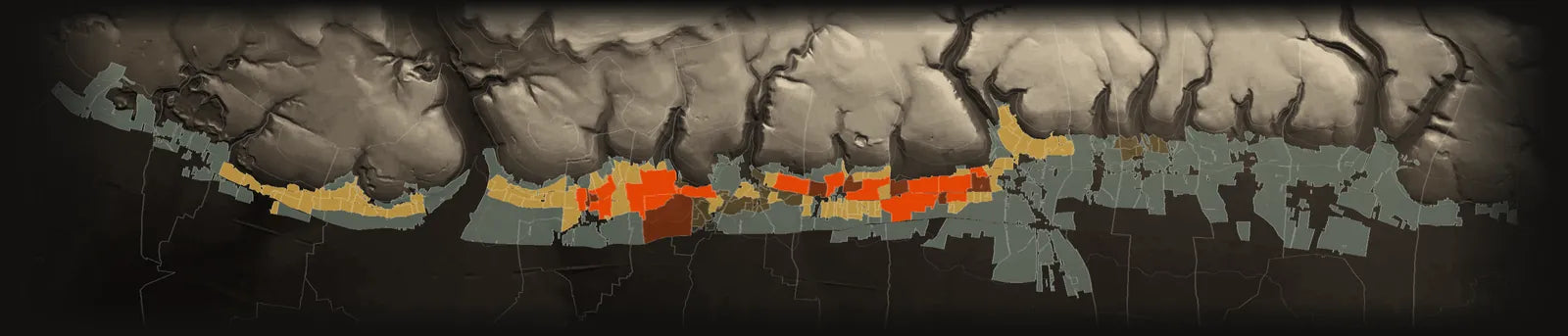
The Côte de Nuits is the northern half of the Côte d'Or and takes its name from the small town of Nuits-Saint-Georges. From Dijon to Corgoloin, for some twenty kilometers, the vines occupy the east-facing slope that descends from the limestone plateaus of the Hautes Côtes toward the Bresse plain; in places the cultivated band is just 200–300 meters wide. Pinot Noir dominates here, while whites, almost always from Chardonnay, are few.
This narrow hillside holds most of Burgundy's Grands Crus, 24 of 33: all are red except Musigny, which on less than a hectare also produces a white wine. They follow one another through the communes of Gevrey-Chambertin, Morey-Saint-Denis, Chambolle-Musigny, Vougeot, Flagey-Echézeaux, and Vosne-Romanée; farther north lie Marsannay and Fixin, farther south Nuits-Saint-Georges and, at the southern end, the three communes of the Côte de Nuits-Villages appellation: Prémeaux-Prissey, Comblanchien, and Corgoloin. Yet, counting Village, Premier Cru, and Grand Cru, the Côte de Nuits accounts for only about 6% of Burgundy's area in production.
The great landowners of the past include the Dukes of Burgundy, the bishoprics of Autun and Langres, and the abbeys of Cluny and Cîteaux. The Clos de Vougeot is the work of the Cistercians of Cîteaux: they established it around 1110 and remained its owners until the Revolution. Since July 4, 2015, the climats of the Côte de Nuits have been inscribed on the UNESCO World Heritage List, together with those of the Côte de Beaune and the towns of Dijon and Beaune. The available Côte de Nuits wines are listed below.
Credits and sources. Photo: Jean de l'Auxois · CC BY-SA 4.0 · Wikimedia Commons. Map: IGN (RGE ALTI®, BD TOPO®), INAO · Licence Ouverte 2.0.
